|
Environmental Lien and AUL
basics
In 2005, the American Society of Testing and
Materials introduced the new standard (ASTM Standard E-1527-05) for
Phase 1 environmental site assessment reports, and environmental
liens. The implementation of this standard was delayed until November
1, 2006.
For professionals who provide these Phase 1 ESA's,
part of the accepted "All Appropriate Inquiries" includes searching
title records for the subject property.
AFX Title Search, an authority on title searching
since 1995, offers title search products tailored for these ESA's.
Providers typically require searching for the following items:
- Environmental Liens
- AUL's
- Ownership history
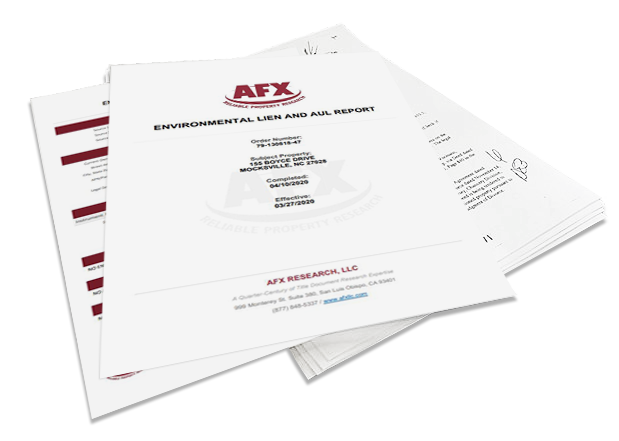
Click Here for Sample Report
The standard specifies ‘environmental liens” by
name, making it a crucial piece of included data in a Phase 1 ESA.
However, obtaining environmental lien records for a particular
property is more complex than it appears. Initially, ESA providers
turned to traditional real estate title abstractors to compile these
search results. AFX has found that environmental liens (and activity
and usage limitations, or AUL’s) often are found in places outside the
scope of a traditional real estate title search.
The definition of an environmental lien is much more broad in scope
than a typical “property lien”. Real estate liens are clearly defined,
and are located using traditional title searching methods, which have
been used for decades. In addition, conventional real estate liens
have a recording and indexing mechanism relatively uniform across
various jurisdictions of municipalities, usually counties.
“Environmental Liens” are different in many ways. The types of records
that can be classified as environmental liens come in a wide variety,
and are recorded in dozens of dissimilar manners.
Originally, an environmental lien was a financial record of a debt, or
financial liability, matching the obligation of a property owner to
correct environmental damage. A simple example is a lien of a
specified dollar amount, in response to a chemical spill at a
property. The dollar amount corresponding to the amount required to
rehabilitate the property to its pre-spill condition.
Since the introduction of the new ASTM standard in 2005, and its
requirement since 2006, many other types of remedial records have been
issued as environmental liens, and AUL’s. AFX has noticed that
government and private agencies have recognized that environmental
liens and AUL’s are now scrutinized as part of a property financing or
transfer. These records are now part of a properties potential
liabilities which must be addressed by the settlement system, as part
of any property transaction.
Because of this, interested parties outside the normal environmental
oversight entities are more often using environmental lien filings as
a method to advance their interests. Since the resolution or
acknowledgement of environmental liens is a contingency of a
transaction, issues that were once disregarded for lack of an
enforcement method are now being considered under the umbrella of
environmental liens, or AUL’s.
Because of this, searching for environmental liens needs to go beyond
the scope of a one-source research project. Environmental liens are no
longer found only within the property records index. Items which could
be considered to be an environmental lien can now be listed in dozens
of systems and records offices.
As an example, AFX recently found a record of an AUL listed in the
records of the Department of Fish & Game. In this instance, there was
a large tract of land which contained several streams and branches. A
was concrete pad was being installed on the property for a foundation
of a small gazebo. During construction, some dry cement mix was lost
into a feeder stream.
This stream fed waterways often used for recreational fishing by the
public. The Department of Fish & Game created an AUL, restricting the
property from being used for fishing, where fish would be used for
human consumption. While this would not require any immediate action
on the part of the property owner, any financing activity or transfer
would trigger a Phase 1 ESA, and therefore an environmental lien
search.
In order to resolve the ‘fish AUL” the owner would need to remedy the
situation to the satisfaction of the Department of Fish & Game. In
effect, the department now had a mechanism to enforce it’s interests,
where none may have existed in the past. Previously, a minor spill of
questionable severity such as this would not have any action taken
since there would be little consequence.
Searching for environmental liens therefore requires a good-faith
effort to locate these records in various places. The locations of the
listings and documents varies by jurisdiction, and the type of
property.
Quality vendors are not in abundant supply. Environmental lien
searching is a relatively new industry. AFX/ TitleSearch.com /
EnvironmentalLiens.com has been at the forfront of this industry since
inception. Although there was some interest prior to 2005, searching
for these records has not become common until late 2006. Most
traditional real estate title researchers are not interested in this
type of work, since it is a low-margin and tedious nature. The records
are scattered across many different offices, and these searchers are
used to going to one records room to pull documents.
A few examples of locations where environmental
liens can be found are:
- Zoning records
- Licensing boards
- Environmental agencies
- Property records
- Department of revenue
Each state and county requires a different list of
sources to search. In addition, these records may exist at the city,
county, state, or federal levels. There may be dozens of locations to
search on a particular property.
At AFX, we have had inquiries and orders for
environmental lien searches since 2004. Over the years, we have
developed a system to search the appropriate records offices specific
to a particular county, city or municipality, depending upon where the
property is located. We have learned that certain types of properties
may need additional inquires to agencies which would not seem to be
related to environmental liens.
For example, in certain states, we find environmental liens and AUL’s
listed in the offices of licensing for occupations. The cosmetology
licensing board may list an AUL or environmental lien if hair
chemicals are not disposed of properly. They may have had little
enforceable consequences prior to ASTM E-1527-05.
Selecting a quality provider of environmental lien searches is an
important part of creating an ESA. Environmental lien searching has
only been around for little more than a year. Be sure your provider
understands the depth of this area of knowledge, and has the
appropriate experience. Talking to a representative from a provider,
and asking a few probing questions is usually enough to determine if
the provider is knowledgeable.
Home Page
To speak with a title representative call:
877-TITLE-37
(877-848-5337)
Enter your email address for
our newsletter:
|